Ancient Wonders of Turkey, Greece & Egypt
23 Nov 2027
From £1,849 per person
Seller's advertised starting price. Confirm dates, party and inclusions.
Offered by Connoisseur Travel
Greek island beaches and historic sites
Crete is Greece’s largest island, with varied coastlines, mountain landscapes and towns including Heraklion, Chania and Rethymno. Visitors can combine beach stays with archaeological sites and inland villages.
Average daytime highs · °C
Heraklion (modelled reference) · 1991–2020
23 Nov 2027
From £1,849 per person
Seller's advertised starting price. Confirm dates, party and inclusions.
Offered by Connoisseur Travel
Crete's grown-up corner, where a bottomless lake meets luxury bays.
Explore Agios Nikolaos & Elounda BayA Venetian harbour, pink-sand beaches and the best food in Crete
Explore Chania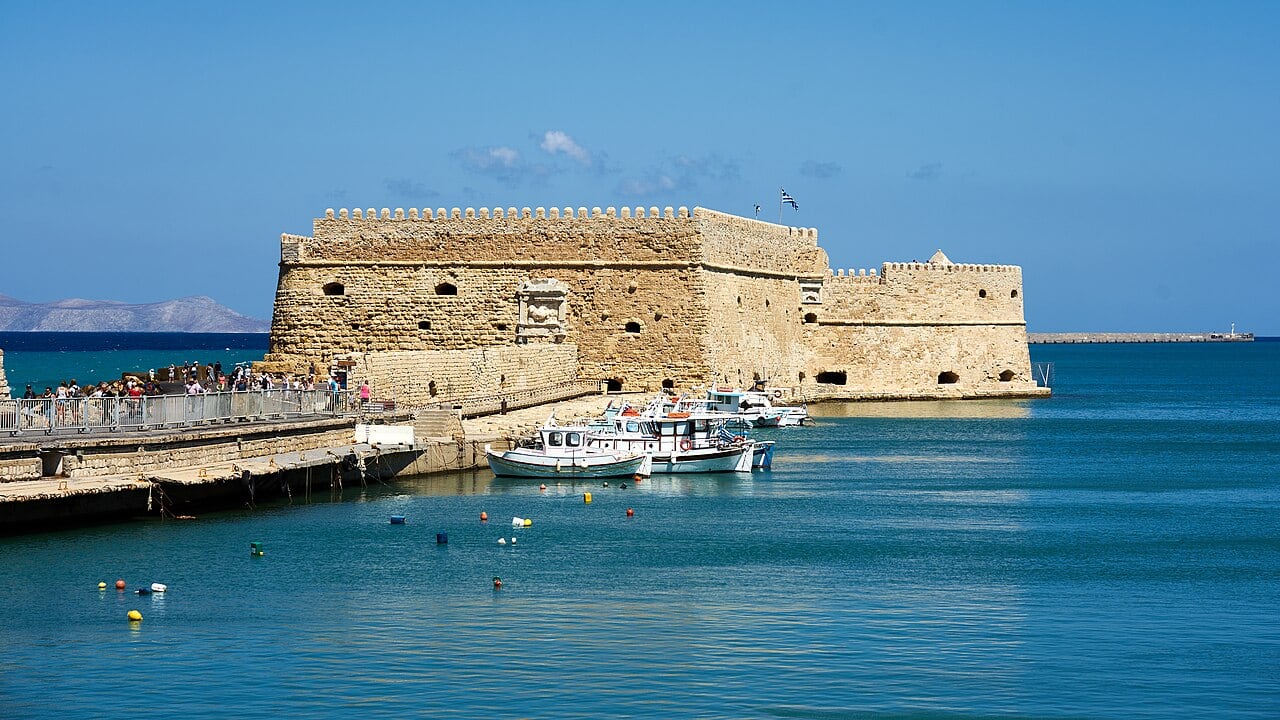
Crete’s capital and a gateway to the island
Explore HeraklionMinoan palaces by day, five-star hideaways on the Mirabello Gulf by night.
Explore Heraklion & EloundaAll-inclusive beach strips, waterparks and Crete's rowdiest bar scene.
Explore Hersonissos & MaliaThe island is large enough for airport choice and transfer time to matter. Compare the location of your resort, the coastline it faces and the travel involved in any excursions you want to include.
Crete stretches about 260km from east to west, making it one of the largest islands in the Mediterranean. The White Mountains and Psiloritis ranges run through the interior, dropping steeply to the coast on both sides and creating dramatic gorges, hidden coves and isolated beaches that you'd struggle to find anywhere else in Europe.
The island splits broadly into four regions. The west (Chania) is the most scenic, with the Venetian harbour town of Chania, the Samaria Gorge and the wild beaches of the southwest coast. The centre (Heraklion/Rethymno) has the largest city, the Minoan palace of Knossos and the charming old town of Rethymno. The east (Lasithi) is quieter and more upmarket, with Agios Nikolaos, the Spinalonga fortress and Elounda's luxury resorts.
Crete is different from the Cyclades or Ionian islands. It's bigger, wilder and more independent in character. Cretans are famously proud of their island, their food and their traditions. The cuisine alone is worth the trip — built around wild greens, olive oil, local cheeses and grilled meat that puts most mainland Greek restaurants to shame.
Two airports serve the island: Heraklion in the centre and Chania in the west, both with direct UK flights in summer. A hire car is strongly recommended — Crete is too big and too varied to experience from a single resort.
Crete's size is its superpower. Unlike smaller Greek islands where you can run out of things to do in a week, Crete reveals more the longer you stay. The landscape shifts from one valley to the next — rugged gorges give way to olive groves, which give way to sandy beaches, which give way to mountain villages where time seems to have stopped.
The food sets it apart from every other Greek island. Cretan cuisine is recognised as one of the healthiest diets in the world, and eating in a village taverna here — wild greens, fresh cheese, lamb from the hills, all drenched in local olive oil — is one of the great food experiences in Europe.
Destination photographs, not photographs of a specific holiday deal. Images resized for display.
Long-term modelled averages for Heraklion, not a forecast or an average for all of Crete. Local conditions, elevation and coastlines can differ from the approximately 0.5° × 0.625° model grid. Precipitation includes rain and the water equivalent of snow. TripBuster calculated mean daily highs and mean monthly precipitation totals from NASA Langley Research Center’s POWER project (Daily API v2.10.0, MERRA-2; accessed 12 October 2026).
| Month | Daytime high (°C) | Precipitation (mm) |
|---|---|---|
| Jan | 14.2 | 93.6 |
| Feb | 14.2 | 75.5 |
| Mar | 15.7 | 48.9 |
| Apr | 18.4 | 22.9 |
| May | 22.1 | 14.6 |
| Jun | 25.7 | 5.2 |
| Jul | 27.5 | 2.1 |
| Aug | 27.7 | 3.6 |
| Sep | 26 | 17.4 |
| Oct | 22.8 | 47.4 |
| Nov | 19.2 | 63.8 |
| Dec | 15.8 | 92.6 |
Source: NASA POWER / MERRA-2 (opens in a new tab), Heraklion (modelled reference), 1991–2020.
Venetian harbour, Ottoman minarets and the best-preserved old town on Crete
Explore Rethymnon & the Old TownCrete's southern position means a longer season than most Greek islands. Beach weather runs from late April through October.
May and June are beautiful — wildflowers in the mountains, warm days (24-28°C) and the sea warming up nicely by June.
July and August are hot (30-35°C) and busy, but the island's size absorbs the crowds better than smaller islands. The Meltemi wind can be strong on north-facing beaches.
September is many regulars' favourite month. Sea temperatures peak, crowds thin and the light turns golden. October stays warm on Crete long after other islands have shut down for winter.
Two airports serve Crete with direct UK flights: Heraklion (HER) in the centre and Chania (CHQ) in the west. Flight time is approximately 3.5-4 hours.
Heraklion is the larger airport and closer to the main resort areas of the north coast. Chania is smaller and serves western Crete, including the town of Chania and the Apokoronas area.
EasyJet, Jet2, TUI, Ryanair and British Airways all operate seasonal routes. A hire car is highly recommended — Crete is 260km long and public transport, while functional, doesn't reach the best beaches and mountain villages.
Cretan food is a cut above standard Greek taverna fare. The island has its own culinary identity built on ingredients from the mountains and the sea.
Start with dakos — a barley rusk soaked in olive oil and topped with chopped tomatoes, mizithra cheese and capers. It's Crete's answer to bruschetta and you'll find it everywhere.
Lamb and goat are the main meats, often slow-cooked in clay pots (kleftiko) or grilled over charcoal. Wild greens (horta) gathered from the hillsides are served warm with olive oil and lemon — simple and delicious.
Cheeses are a revelation. Graviera (hard, nutty) and mizithra (soft, fresh) are made in villages across the island. Pair them with thyme honey for dessert.
Olive oil is the foundation of everything. Crete produces some of the finest oil in the Mediterranean, and you'll taste the difference. Raki (the local grape spirit) is offered free at the end of almost every meal — refusing is practically an insult.
Crete works for a remarkably wide range of travellers. Families love the shallow beaches of the north coast and the waterparks near Heraklion. Couples gravitate towards the boutique hotels around Chania and Elounda. Walkers and hikers have the Samaria Gorge and dozens of lesser-known trails. Foodies come specifically for the Cretan cuisine. And anyone who wants more from a Greek holiday than just beach and pool will find enough on Crete to fill a month.
Western Crete's harbour town has a crescent of pastel Venetian buildings curving round a 1595 harbour, the 1570 Egyptian lighthouse at the entrance, the Firkas Fortress maritime museum and labyrinthine back streets filled with family tavernas.
Europe's longest gorge runs 16km through the White Mountains from Xyloskalo pass at 1,230m down to the Libyan Sea at Agia Roumeli, a 5-6 hour one-way walk through towering limestone walls with the Iron Gates section just 4m wide at its narrowest.
The 4,000-year-old palace complex 5km from Heraklion was the heart of Europe's oldest civilisation, with Arthur Evans's reconstructed throne room, the bull-leaping fresco, the Queen's Megaron and the legend of the Minotaur's labyrinth.
The south-west tip's shallow turquoise lagoon has pink sand coloured by crushed shells, waist-deep water extending hundreds of metres offshore, the adjacent Elafonissi islet reachable on foot at low tide and Kedrodasos beach 2km away for quieter swimming.
The world's healthiest diet centres on dakos (barley rusk with tomato, mizithra cheese, oregano), kleftiko (slow-cooked lamb in clay pot), graviera cheese, wild mountain horta greens in olive oil, and raki grape spirit offered free at meal's end.
Confirm dates and arrangements before making travel plans.
The Rethymno wine and food festival across 10 days of late July celebrates Crete's UNESCO-listed Mediterranean diet with cooking demonstrations, raki distillation, traditional cheese-making and nightly open-air feasts in the old town Venetian square.
Crete's Orthodox Easter is Greece's most atmospheric with Saturday midnight resurrection services at every village church, the Good Friday Epitaphios procession through old towns, and the Sunday lamb-on-the-spit feasts in village squares.
The Venetian harbour's late-June Naftotaverna festival stages five nights of outdoor traditional music on the harbour waterfront, Greek-dance demonstrations at Firkas Fortress, yacht-regatta race and the closing fireworks-and-fish-grilling feast.