Sicily by Train
From £1,739 per person
Seller's advertised starting price. Confirm dates, party and inclusions.
Offered by Constant Travel
An active volcano glowing at night, Greek temples more intact than Greece's own and street food worth queuing an hour for.
An active volcano glowing at night. Greek temples more intact than anything in Greece. Street food that makes grown men queue for an hour. And a coastline that runs from sandy beaches to volcanic black rock. Sicily is Italy turned up to maximum volume.
Monthly guide averages and suggested seasons. These are not a weather forecast; conditions vary within a destination.
| Month | Average high (°C) | Rainfall (mm) | Season |
|---|---|---|---|
| Jan | 15 | 81 | Low season |
| Feb | 15 | 60 | Low season |
| Mar | 17 | 50 | Shoulder season |
| Apr | 19 | 38 | Shoulder season |
| May | 23 | 18 | Recommended |
| Jun | 28 | 8 | Recommended |
| Jul | 32 | 8 | Recommended |
| Aug | 32 | 13 | Recommended |
| Sep | 28 | 60 | Recommended |
| Oct | 23 | 105 | Recommended |
| Nov | 19 | 90 | Shoulder season |
| Dec | 16 | 79 | Low season |
From £1,739 per person
Seller's advertised starting price. Confirm dates, party and inclusions.
Offered by Constant Travel
A Byzantine cathedral, a 270-metre limestone rock and sand right below the old town
Explore CefaluThe best street food in Italy and mosaics that outshine Ravenna.
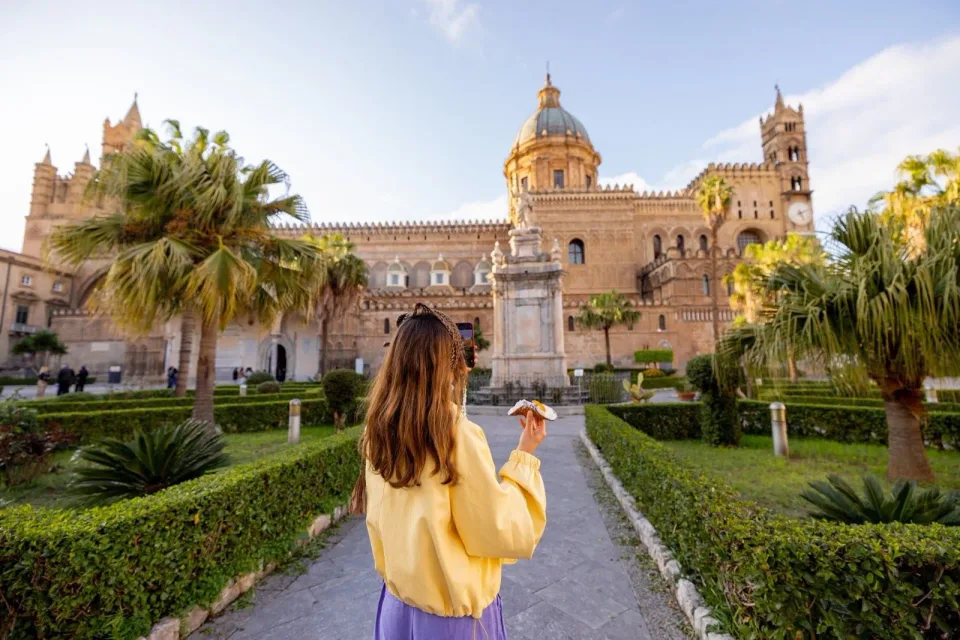
Explore PalermoA Greek theatre with Mount Etna behind and the Ionian Sea below, Sicily's most glamorous town since the Grand Tour
Explore TaorminaSicily is the largest island in the Mediterranean and feels like a country in its own right. The layers of civilisation are extraordinary: Greek temples at Agrigento and Syracuse, Roman mosaics at Piazza Armerina, Arab-Norman churches in Palermo, and Baroque towns rebuilt after the 1693 earthquake in the south-east.
Mount Etna dominates the eastern side, an active volcano that you can hike, drive up or ski in winter. Taormina, perched on a clifftop with Etna behind and the sea below, has been the island's most famous resort since the Grand Tour era. Palermo on the north coast is one of the most exciting and chaotic cities in Italy, with street markets, Arab-Norman architecture and a food culture that draws from every civilisation that has passed through.
The beaches are excellent and varied: the golden sand of San Vito Lo Capo in the north-west, the volcanic black beaches below Etna, and the turquoise coves of the Egadi and Aeolian islands offshore.
Sicily's food is Italy's most diverse: arancini, pasta alla norma, cannoli, granita, cassata, couscous (from the Arab influence), and street food that includes some of the most addictive snacks on the planet.
Sicily offers a combination of culture, volcano, beaches and food that no other Italian island can match. It is big enough (25,000 sq km) to support a week or two without running out of things to do. The growing direct flight connections from the UK make it increasingly accessible.
April to October. May-June and September-October are ideal: 22-28C. July-August is very hot (32-40C) in the interior. The coast is tempered by sea breezes. Sicily has a long season and mild winters (12-16C). Etna can be visited year-round.
Destination photographs, not photographs of a specific holiday deal. Images resized for display.
Two airports: Catania (CTA) serves eastern Sicily (Taormina, Etna, Syracuse), 2 hrs 50 min from London with easyJet, Ryanair, Wizz Air and BA. Palermo (PMO) serves western Sicily, with easyJet, Ryanair and BA from Gatwick, Stansted and Luton. Transfer from Catania to Taormina is about 1 hour.
Sicilian food is extraordinary. It is Italian but influenced by Greek, Arab, Spanish and French cooking. Every town has its own specialities.
Try: arancini (fried rice balls, a Sicilian obsession), pasta alla norma (aubergine, tomato, ricotta salata), pasta con le sarde (sardines, fennel, pine nuts, raisins), cannoli (crispy tubes filled with sweet ricotta), granita con brioche (iced fruit or almond slush with a warm brioche bun) for breakfast, and panelle (chickpea fritters). The street food in Palermo and Catania is world-class. Wines from Etna (both red and white) are among Italy's most exciting.
Couples and culture seekers are the primary market. Self-drive touring holidays work well (Sicily rewards exploration). Food tourists are a growing segment. Taormina suits luxury seekers. Families do well on the beaches. Active travellers hike Etna and the Aeolian Islands. Less suited to anyone wanting a simple beach-and-pool holiday.
Europe's highest and most active volcano (3,357 metres and rising) dominates eastern Sicily. Cable car and 4x4 jeep tours climb to 2,900 metres, and overnight summit hikes run when activity allows.
The 5th-century BC Doric temples at Agrigento are among the best-preserved Greek monuments anywhere. Eight temples line the ridge, with the Temple of Concordia almost intact. UNESCO listed since 1997.
The clifftop town with Etna behind and the Ionian Sea below has been the island's most famous resort since the Grand Tour. The Greco-Roman theatre frames Etna behind the stage, perfect at sunset.
The chaotic Ballaro, Vucciria and Capo markets fry arancini, panelle, sfincione, pani ca' meusa (spleen sandwich) and cannoli to order. Among the best street food scenes in the Mediterranean.
The crescent of white sand on Sicily's north-western tip backed by the Monte Monaco massif is the island's most photographed beach, with shallow turquoise water and a cous-cous-and-fish food festival in September.
Confirm dates and arrangements before making travel plans.
Catania's three-day patron saint festival from 3 to 5 February draws around a million people, the largest Catholic festival in Europe after Holy Week in Seville and Corpus Christi in Cuzco.
The week-long international cous cous festival on the north-western tip of Sicily celebrates the Arab heritage of Sicilian cooking with chefs from across the Mediterranean and live music on the beach.