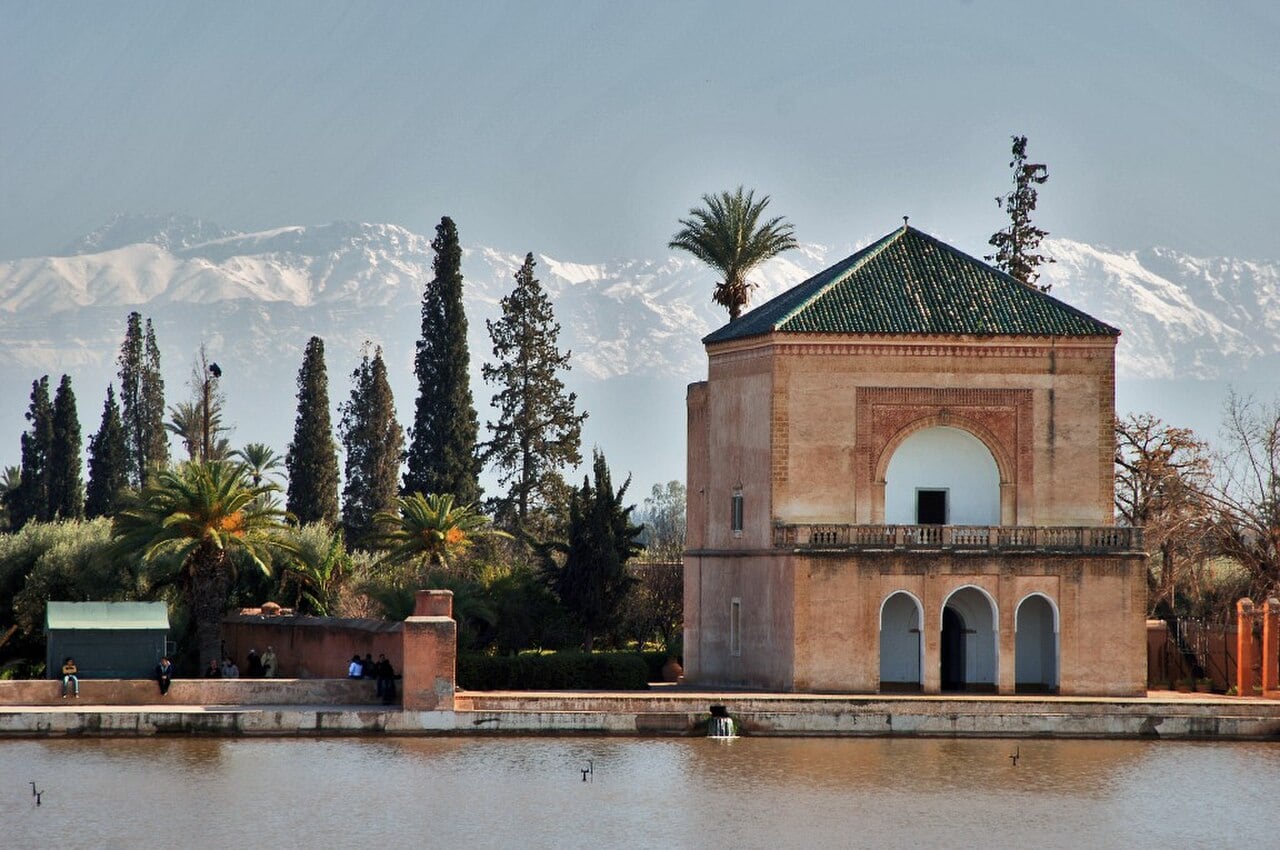
RAK
Marrakech Menara Airport
A gateway to consider
A gateway for Marrakech and nearby resorts. Agadir uses a different airport for its coastal holidays.
- Confirm the airport on your flight booking
- Check whether hotel or port transfers are included
Medinas, Atlantic beaches and Atlas scenery.
Morocco brings together historic cities, mountain landscapes and Atlantic seaside resorts. Marrakech is an inland city break rather than a beach destination; Agadir offers a coastal base. A longer journey can include the Atlas Mountains or desert landscapes, but distances make careful planning worthwhile.
A gateway to consider
A gateway for Marrakech and nearby resorts. Agadir uses a different airport for its coastal holidays.
Average daytime highs · °C
Marrakesh (modelled reference) · 1991–2020
Morocco brings together historic cities, mountain landscapes and Atlantic seaside resorts.
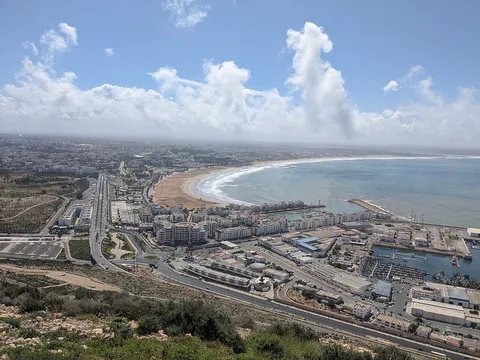
A 10km Atlantic beach with 300 sunny days and all-inclusive prices a fraction of the Canaries
Explore Agadir & the Atlantic CoastPhoto by Abdeaitali on Wikimedia Commons, CC BY-SA 4.0 (https://commons.wikimedia.org/wiki/File:Beach_of_Agadir_from_Kasbah_of_Agadir_Oufella.jpg)
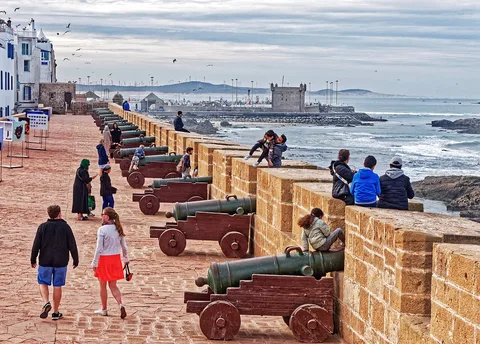
Blue-shuttered medina on the Atlantic with kitesurf wind.
Explore EssaouiraPhoto by Holger Uwe Schmitt on Wikimedia Commons, CC BY-SA 4.0 (https://commons.wikimedia.org/wiki/File:%22Ein_bemerkenswertes_historisches_Denkmal%22._16.jpg)
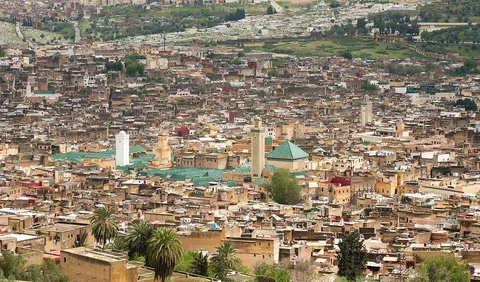
The medieval medina, the tanneries and Morocco's food capital.
Explore Fes & the Imperial CitiesPhoto by Petar Milošević on Wikimedia Commons, CC BY-SA 4.0 (https://commons.wikimedia.org/wiki/File:Medina_of_Fes,_Marocco.jpg)
Choose between a riad in a historic medina and a resort outside the centre. Medina lanes may be inaccessible to cars, while a Palmeraie hotel can require transport for sightseeing. Ask how transfers work at your chosen property.
Spring and autumn often suit city walks and touring. Summer heat can be intense inland, while mountain conditions are different from those on the coast. Desert excursions involve substantial travel, so check driving times and overnight arrangements.
Allow time for markets, gardens and local food without overloading each day. Dress and behaviour should respect local customs, particularly around religious sites. Check current entry advice and the exact locations included in an organised tour.
Marrakech centres much of its visitor life on Jemaa el-Fna and the surrounding souks, with riad courtyards and gardens offering other places to pause. Fez draws attention to the architecture and craft traditions of Fez el-Bali, where a visit is as much about noticing the details of a street as reaching a particular sight.
Essaouira turns towards the Atlantic. Its ramparts, fishing port and white and blue façades create a coastal setting, while galleries and medina streets give you reasons to explore beyond the waterfront. Rabat offers a different city experience again, combining the Kasbah of the Oudayas and the ruins of Chellah with contemporary cultural venues.
The medinas remain places where people live and work, with craft shops alongside homes and religious buildings. In Rabat, the Mohammed VI Museum of Modern and Contemporary Art adds a more recent chapter to a stay centred on historic sites. Food adds another thread, from vegetable starters and tagines to mint tea and pastries.
Morocco has a varied climate. Marrakech is best from March to May and September to November (20-30C). Summer (June to August) is very hot (35-45C). Winter (December to February) is mild (15-22C) and pleasant for city exploration. Agadir has year-round sunshine (20-30C, the warmest Atlantic coast in Morocco). The Sahara is best from October to April. The Atlas Mountains have snow in winter (December to March) and are best for trekking from April to October.
Destination photographs, not photographs of a specific holiday deal. Images resized for display.
Long-term modelled averages for Marrakesh, not a forecast or an average for all of Morocco. Local conditions, elevation and coastlines can differ from the approximately 0.5° × 0.625° model grid. Precipitation includes rain and the water equivalent of snow. TripBuster calculated mean daily highs and mean monthly precipitation totals from NASA Langley Research Center’s POWER project (Daily API v2.10.0, MERRA-2; accessed 12 October 2026).
| Month | Daytime high (°C) | Precipitation (mm) |
|---|---|---|
| Jan | 17.7 | 37.6 |
| Feb | 19.3 | 35.2 |
| Mar | 22.3 | 40.5 |
| Apr | 24.6 | 31.1 |
| May | 28.5 | 13.1 |
| Jun | 33.2 | 4.1 |
| Jul | 38 | 5.3 |
| Aug | 37.7 | 5.9 |
| Sep | 32.4 | 13.2 |
| Oct | 27.5 | 24.6 |
| Nov | 21.9 | 46 |
| Dec | 18.7 | 35.1 |
Source: NASA POWER / MERRA-2 (opens in a new tab), Marrakesh (modelled reference), 1991–2020.
Marrakech (RAK): 3 hours 30 minutes from London. Direct flights from Gatwick, Stansted, Luton, Manchester, Birmingham and Bristol with Ryanair, easyJet, BA, TUI and Wizz Air. The airport is 15 minutes from the medina.
Agadir (AGA): 3 hours 45 minutes from London. Direct from Gatwick and Manchester with TUI, easyJet and Ryanair.
Fes (FEZ): 3 hours 15 minutes from London. Direct from Stansted with Ryanair.
Casablanca (CMN): 3 hours 15 minutes from London. Direct from Heathrow with BA and Royal Air Maroc. Hub for domestic connections.
Domestic flights between Moroccan cities are available with Royal Air Maroc but the road network (coaches and private transfers) is more commonly used.
There is plenty to try beyond one familiar tagine. Start with zaalouk, an aubergine preparation, or a selection of cooked vegetable dishes. Tagines themselves vary, with fish, chicken, meat or vegetables and sometimes dried fruit, so read the description before choosing.
Couscous may arrive with vegetables and meat or other accompaniments. Harira is a soup combining ingredients such as pulses, tomatoes and pasta, while pastilla brings a pastry element to the meal and can have different fillings.
On the coast, Essaouira's fishing port makes seafood a natural focus. For a pause between visits, mint tea and a pastry offer another way to enjoy Moroccan food without planning a full meal.
Currency: Moroccan Dirham (MAD). UK cards accepted in hotels, larger restaurants and shops. Cash is essential for the medinas, souks, taxis and smaller establishments. ATMs are widely available.
Language: Arabic and Berber (official). French is widely spoken. English is increasingly common in tourist areas.
Time zone: GMT+1 (same as CET). 1 hour ahead of the UK in winter.
Visa and entry: see Visa Advisory above.
Plug type: Type C and Type E (European two-pin). Bring a European adaptor.
Water: Do not drink the tap water. Bottled water is cheap and everywhere.
Tipping: Expected. 10% at restaurants. Small tips for guides, drivers, riad staff and anyone who provides a service in the medina.
Dress: Morocco is a Muslim country. Modest dress is appreciated, particularly outside tourist areas. Shoulders and knees should be covered when visiting mosques (non-Muslims cannot enter most mosques, with the exception of Hassan II Mosque in Casablanca).
Emergency number: 19 (police), 15 (ambulance).
The walled old town is a warren of narrow lanes, spice souks, carpet shops and hidden riads. Getting lost is part of the experience. The Ben Youssef Madrasa is the medina's architectural highlight.
The main square of Marrakech transforms every evening into an open-air theatre of storytellers, snake charmers, food stalls and Gnawa musicians. UNESCO-listed as a masterpiece of intangible heritage.
An overnight trip from Marrakech to Erg Chebbi near Merzouga, with a camel ride into the orange dunes at sunset, a Berber tent with proper beds, and stars like you've never seen them.
A riad is a merchant's house built around a central courtyard, usually with a plunge pool and fountain. Every medina is full of them, converted into boutique hotels with rooftop terraces for breakfast.
The High Atlas rises directly behind Marrakech, with day trips to the Ourika Valley and multi-day treks to the summit of Jebel Toubkal, North Africa's highest peak at 4,167 metres.
The Rif Mountain town where every wall, door and step is painted a shade of sky blue. Now a four-hour drive from Tangier or Fes, and one of the most photographed places in Africa.
Not required
UK passport holders can visit Morocco visa-free for stays up to 90 days. Passport must be valid for at least 3 months beyond planned departure with one blank page. Make sure you receive an entry stamp on arrival. Proof of onward travel, accommodation and sufficient funds may be requested. Effective May 2026 — check gov.uk/foreign-travel-advice/morocco for current rules before booking.
No mandatory vaccinations. Be up to date with routine UK vaccinations including tetanus; hepatitis A and typhoid recommended. Tap water is generally not safe — drink only bottled or filtered water. Healthcare in Casablanca, Marrakesh and Rabat is reasonable in private clinics; rural areas more basic. Strong sun and heat in summer (Jul-Aug 35°C+ in interior, very hot in Sahara) — sun protection and hydration essential. Mountain weather can change rapidly in the Atlas (winter snow). Comprehensive travel insurance with full medical and evacuation cover essential. Effective May 2026 — check fitfortravel.nhs.uk for any updates before travel.
Entry and health requirements can change. Check current official travel advice (opens in a new tab) for your passport and circumstances.
Confirm dates and arrangements before making travel plans.
Three days of Gnawa spiritual music fused with jazz, funk and reggae take over the coastal town of Essaouira. Free stages in the medina, paid headliners at the ramparts, the biggest music festival in Morocco.
The Valley of Roses in the Dades celebrates its rose harvest with a three-day festival of parades, Berber music, perfume stalls and the coronation of the Rose Queen.
Ten days of international film screenings, masterclasses and red-carpet events in a purpose-built outdoor cinema on the Jemaa el-Fnaa square, drawing major directors and actors.