The Pitons from Sugar Beach
The two volcanic spires of Gros Piton and Petit Piton rise 770 and 743 metres straight from the sea, with the Viceroy Sugar Beach resort set between them. The defining image of Caribbean luxury.
The Pitons, rainforest and Caribbean bays
Saint Lucia is a mountainous Caribbean island known for the twin volcanic peaks of the Pitons. Soufrière is a base for exploring the southwest, while the north has the marina and beaches around Rodney Bay.
Average daytime highs · °C
Castries (modelled reference) · 1991–2020
Check your chosen itinerary for the arrival airport and available flights.
Serves Castries
Serves Vieux Fort
There are no current Saint Lucia deals on TripBuster. An independent travel expert can help you explore dates, hotels and a budget that works for you.
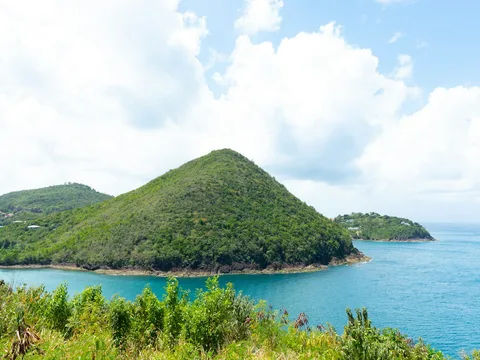
Explore holidays and deals in Rodney Bay & the North.
Explore Rodney Bay & the NorthPhoto by Karl Moore on Unsplash (https://unsplash.com/photos/a-small-island-in-the-middle-of-a-body-of-water-TF7xU8IKb98)
Explore holidays and deals in Soufriere & the Pitons.
Explore Soufriere & the PitonsCombine time beside the sea with rainforest excursions, botanical gardens and views of the volcanic landscape. Road journeys across the island can take longer than their distance suggests, so compare transfer times when choosing a resort.
Soufrière makes a useful starting point for understanding St Lucia’s volcanic landscape. On the southwest coast, the town sits near Gros Piton and Petit Piton, the two peaks that rise beside the sea. Spend time on the waterfront and choose places to explore around it rather than treating the Pitons as a photograph alone.
At Sulphur Springs, a guided route passes bubbling mud pools and active vents. Diamond Falls Botanical Gardens offers a different view of the same landscape, with tropical plants and a waterfall coloured by mineral deposits. Cocoa estates add a food connection, with visits that follow chocolate from the cacao grove to the finished bar.
In the northwest, Pigeon Island combines grassy grounds with military ruins from battles between Britain and France. Fort Rodney’s lookout puts the surrounding coastline in view. Build your plans around the places that interest you and check current visitor arrangements. For beach time, follow local warnings and ask about sea conditions before swimming.
St Lucia has a tropical climate year-round. The dry season (January to April) is the most popular and most comfortable: 24-30C, low humidity, clear skies. This is peak season and prices are highest. The wet season (June to November) is warmer and more humid, with short tropical showers (usually in the afternoon). Hurricane season runs June to November, though St Lucia is further south than many Caribbean islands and direct hits are rare. The sea is warm year-round (26-29C).
Explore Soufrière: Spend time along the waterfront and take in views of the Pitons from the surrounding coast.
Visit Sulphur Springs: Follow the guided route through the geothermal area to see its mud pools and active vents.
Walk through Diamond Falls Botanical Gardens: Look at the tropical planting and the mineral-coloured waterfall.
Visit Pigeon Island: Explore the military ruins and make Fort Rodney’s coastal lookout part of your visit.
Destination photographs, not photographs of a specific holiday deal. Images resized for display.
Long-term modelled averages for Castries, not a forecast or an average for all of Saint Lucia. Local conditions, elevation and coastlines can differ from the approximately 0.5° × 0.625° model grid. Precipitation includes rain and the water equivalent of snow. TripBuster calculated mean daily highs and mean monthly precipitation totals from NASA Langley Research Center’s POWER project (Daily API v2.10.0, MERRA-2; accessed 12 October 2026).
| Month | Daytime high (°C) | Precipitation (mm) |
|---|---|---|
| Jan | 26.9 | 75.9 |
| Feb | 26.8 | 59 |
| Mar | 27.1 | 86.8 |
| Apr | 27.7 | 106 |
| May | 28.3 | 115.3 |
| Jun | 28.4 | 146.8 |
| Jul | 28.5 | 161 |
| Aug | 28.8 | 191.8 |
| Sep | 29 | 205.6 |
| Oct | 28.7 | 209.7 |
| Nov | 28.2 | 203 |
| Dec | 27.5 | 95.7 |
Source: NASA POWER / MERRA-2 (opens in a new tab), Castries (modelled reference), 1991–2020.
Arrange a cocoa-estate experience: Learn how cacao becomes chocolate, checking what the visit includes before booking.
Hewanorra International Airport (UVF), at Vieux Fort, is Saint Lucia’s long-haul gateway. George F. L. Charles Airport (SLU), near Castries, handles regional services. Check the code on your ticket and book the road transfer to your chosen part of the island.
Green fig and saltfish is St Lucia’s national dish. The “figs” are green bananas, firm rather than sweet, served with salted fish cooked with onions, tomatoes and peppers. Look for the dish when you want to try something closely associated with the island.
Cocoa and coffee are grown here too. A chocolate-estate visit can connect what you taste with the cacao groves and the process of making a bar. Ask about locally grown coffee when choosing a drink.
Check your accommodation and arrival airport together. Hewanorra is in the south, while George F. L. Charles is near Castries, and a hotel in the north can involve a substantial onward road journey. Hurricane season normally runs from June to November; storms can disrupt roads and utilities. Match walking excursions to your mobility and arrange suitable insurance.
The two volcanic spires of Gros Piton and Petit Piton rise 770 and 743 metres straight from the sea, with the Viceroy Sugar Beach resort set between them. The defining image of Caribbean luxury.
The world's only drive-in volcano sits in a caldera south of Soufriere, with steaming mud pools, sulphurous hot springs and a muddy spa bath said to soften wrinkles and restore youth.
The marine reserve fronting the Anse Chastanet hotel has coral walls dropping to 40 metres just metres from shore, with parrot fish, eels, rays and seasonal turtles. Some of the Caribbean's best snorkelling.
The four-hour round-trip hike to the 770-metre summit is guided, sweaty and worth every step for the view across to Petit Piton, the Caribbean and the mountains of St Vincent on a clear day.
Every Friday evening the northern fishing village closes its streets for steel-drum bands, grilled fish stalls, rum shacks and sound systems. The best weekly street party in the eastern Caribbean.
The six-tier mineral waterfall in the Soufriere Estate runs through botanical gardens planted in 1785, with bathing in the warm sulphur-stained pools where Empress Josephine once bathed as a child.
Not required
Full British citizen passport holders can visit Saint Lucia without a visa for up to six weeks. Your passport must expire after the date you plan to leave. Complete the online immigration form no more than three days before arrival, or complete the form on arrival. Check current requirements before departure.
Review travel-health advice at least eight weeks before departure. Medical care can be expensive and some private facilities require payment in advance. Arrange insurance covering treatment and repatriation, with access to funds if immediate payment is needed.
Entry and health requirements can change. Check current official travel advice (opens in a new tab) for your passport and circumstances.
Confirm dates and arrangements before making travel plans.
The Caribbean's biggest jazz festival fills Pigeon Island National Landmark for a long weekend in early May, with international and Caribbean headliners under the stars at a 17th-century fort.
Two weeks of calypso competitions, J'ouvert morning paint parties and costumed road marches through Castries in July, one of the longer-standing pre-Emancipation Day carnivals in the eastern Caribbean.
The 22 February celebrations of St Lucia's 1979 independence from Britain include a Castries parade, cultural performances at Mindoo Phillip Park and the Prime Minister's flag-raising at Constitution Park.