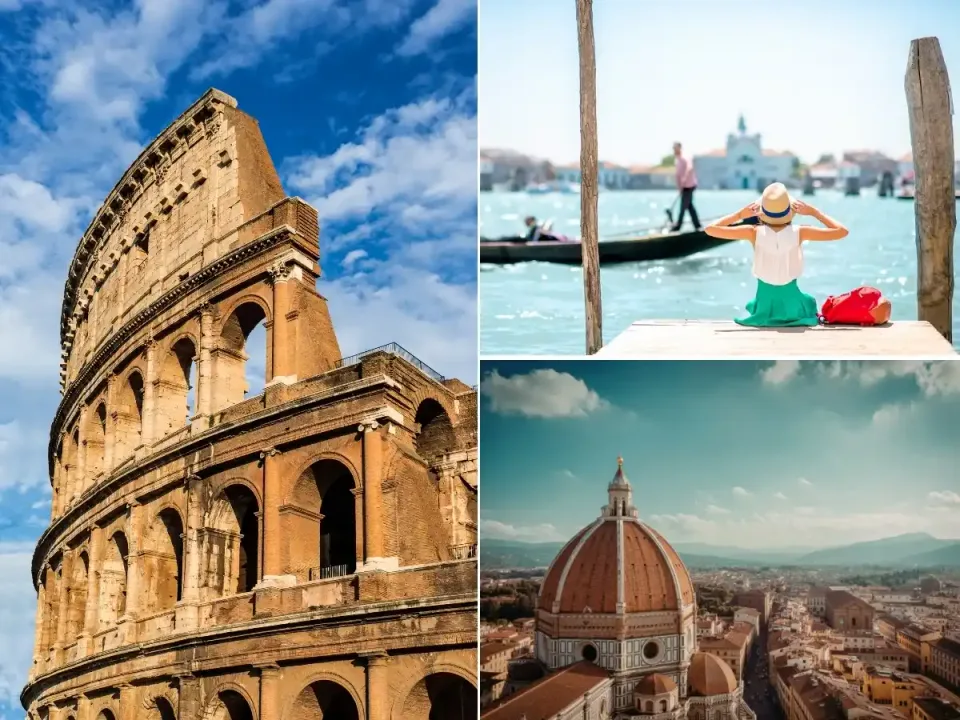
Rome, Venice & Florence Grand Italy Escape
Request a quote
Offered by Plus Holiday
Renaissance art in Florence, Brunello in Montalcino and cypress-lined roads winding through the Tuscan hills.
Cypress-lined roads winding between hilltop towns. Vineyards rolling to every horizon. A city with more Renaissance art than most countries. Tuscany is the Italy of the imagination, and Florence is its extraordinary capital.
Monthly guide averages and suggested seasons. These are not a weather forecast; conditions vary within a destination.
| Month | Average high (°C) | Rainfall (mm) | Season |
|---|---|---|---|
| Jan | 9 | 67 | Low season |
| Feb | 11 | 76 | Low season |
| Mar | 14 | 72 | Shoulder season |
| Apr | 18 | 82 | Recommended |
| May | 22 | 74 | Recommended |
| Jun | 27 | 48 | Recommended |
| Jul | 30 | 29 | Shoulder season |
| Aug | 30 | 33 | Low season |
| Sep | 25 | 86 | Recommended |
| Oct | 19 | 113 | Recommended |
| Nov | 14 | 128 | Low season |
| Dec | 10 | 97 | Low season |
Request a quote
Offered by Plus Holiday
Tuscany occupies a special place in the British imagination of Italy. The rolling hills of the Val d'Orcia (a UNESCO World Heritage landscape), the medieval towers of San Gimignano, the Chianti vineyards and the hill towns of Montepulciano, Montalcino and Cortona have been drawing visitors for centuries.
Florence (Firenze) is the capital and the cultural anchor. The Uffizi Gallery holds one of the greatest collections of Renaissance art in the world. The Duomo cathedral and Brunelleschi's dome dominate the skyline. Michelangelo's David stands in the Galleria dell'Accademia. And the Ponte Vecchio bridge, lined with gold and jewellery shops, is one of the most photographed structures in Italy.
But Tuscany's appeal goes far beyond art. The food is outstanding (Tuscan cooking is the foundation of what the world thinks of as Italian cuisine), the wine regions produce some of Italy's finest bottles, and the landscape, particularly in autumn when the light turns golden, is heart-stoppingly beautiful.
For travel agents, Tuscany works as a Florence city break (3-4 nights), a self-drive touring holiday through the hill towns and vineyards, or a twin-centre with Rome (1.5 hrs by high-speed train).
The combination of Florence's art, the Tuscan landscape, the food and the wine creates one of the strongest cultural holiday products in Europe. The high-speed train from Rome (1.5 hrs) makes twin-centre itineraries easy. Self-drive holidays through the Chianti and Val d'Orcia are a premium product with strong margins.
April to October. May-June and September-October are ideal at 20-28C with excellent light for the landscape. July-August is hot (32-36C) and Florence can be overwhelmingly busy. Autumn (October-November) brings truffle season and the grape harvest. Winter is cool (5-12C) but atmospheric.
Destination photographs, not photographs of a specific holiday deal. Images resized for display.
Fly into Pisa (PSA), 2 hours 10 minutes from London, then 1 hour by train or car to Florence. Or fly into Florence (FLR), with limited direct UK flights from Gatwick with BA and Vueling. Bologna (BLQ) is also useful (40 min by train to Florence). The high-speed train from Rome to Florence takes 1.5 hours.
Tuscan food is rustic, generous and built on superb ingredients. Bread (unsalted, a Florentine tradition), olive oil, beans, wild boar and bistecca (beef) are the foundations.
Try: bistecca alla fiorentina (a massive T-bone from Chianina cattle, served rare), ribollita (bread and vegetable soup), pappardelle al cinghiale (pasta with wild boar ragu), panzanella (bread and tomato salad), lampredotto (tripe sandwich from a Florence street cart), and cantucci dipped in Vin Santo. Drink Chianti Classico, Brunello di Montalcino or Vino Nobile di Montepulciano.
Couples, culture seekers and foodies. Florence is one of Europe's top art-and-culture city breaks. Self-drive touring holidays suit couples and small groups. Wine enthusiasts and cooking-class tourists are a growing market. Families with older children enjoy Florence. Less suited to beach seekers (the Tuscan coast exists but is not the main draw).
The Uffizi Gallery holds one of the world's greatest collections of Renaissance art - Botticelli's Birth of Venus and Primavera, Leonardo's Annunciation, Caravaggio's Medusa. Michelangelo's David stands in the Galleria dell'Accademia a few minutes' walk away. Book both well in advance; queues without a reservation are punishing.
Florence's cathedral, Santa Maria del Fiore, is crowned by Brunelleschi's vast brick dome - finished in 1436 and still the largest brick dome ever built. The 463-step climb to the lantern is one of the great rewards in European travel: you emerge above the rooftops with the whole city laid out beneath you.
This rolling agricultural landscape south of Siena was inscribed by UNESCO in 2004 - cypress-lined roads, conical hills topped with fortified villages and the cradle of the Sienese Renaissance. Pienza, Montalcino and San Quirico d'Orcia are the headline towns. Drive it slowly with no fixed plan; the landscape rewards wandering.
Two of Italy's most celebrated wine regions sit within an hour of each other. Chianti Classico (the original zone, marked with the black rooster) lies between Florence and Siena. Brunello di Montalcino is produced from a single hillside town further south. Most cellars take visitors by appointment - the smaller estates are usually the most rewarding.
Siena's Piazza del Campo is the great medieval square of Italy - shell-shaped, sloping, and home to the Palio horse race twice each summer (2 July and 16 August). Outside race days the city slows right down. The cathedral, with its inlaid marble floor, is one of the most extraordinary in Italy.
The Florentine T-bone, cut from Chianina cattle and grilled rare over wood embers, is a serious commitment - usually served by the kilo for two people to share. Try it at a traditional trattoria like Trattoria Mario or Sostanza, with a glass of Chianti Classico and very little else.
Confirm dates and arrangements before making travel plans.
One of Europe's oldest music festivals, with opera, ballet and orchestral performances at the Teatro del Maggio.
Siena's bareback horse race around the Piazza del Campo, run on 2 July and 16 August. The build-up takes days; the race itself lasts about 90 seconds.
Greve in Chianti hosts a four-day celebration of the region's wines, with tastings, food stalls and producer stands in the central piazza.