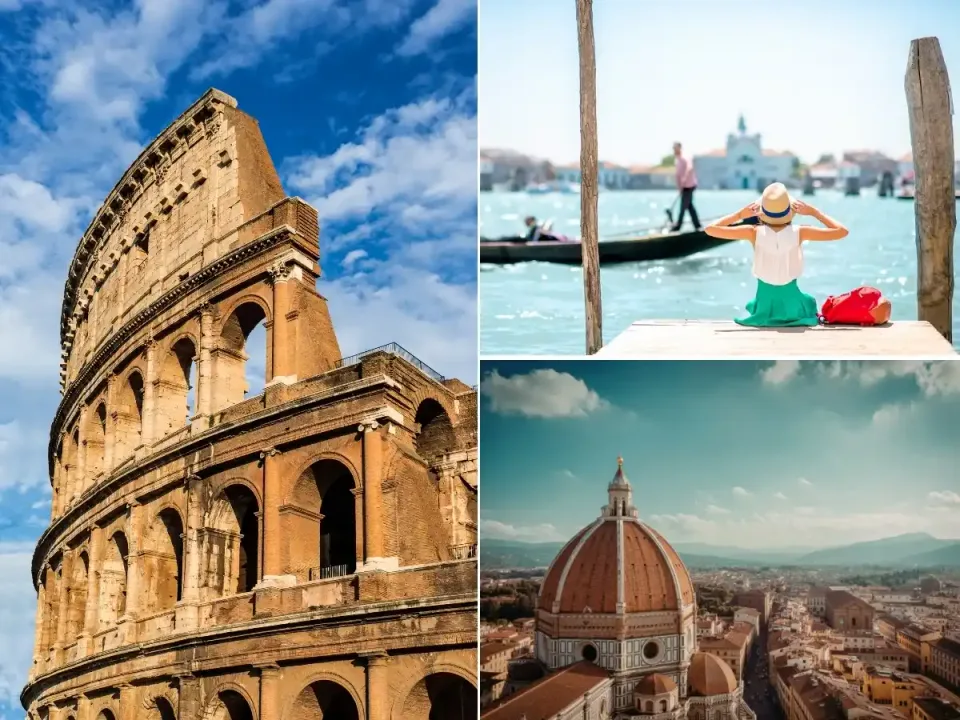
Rome, Venice & Florence Grand Italy Escape
Request a quote
Offered by Plus Holiday
A little inspiration.
A new adventure.
The birthplace of the Renaissance in a compact city you can walk end to end in twenty minutes
Brunelleschi's dome rising above the rooftops. David standing seventeen feet tall in his gallery. The Ponte Vecchio glowing gold at sunset. Florence is the city where the Renaissance happened, and walking its streets still feels like walking through a work of art.
Monthly guide averages and suggested seasons. These are not a weather forecast; conditions vary within a destination.
| Month | Average high (°C) | Rainfall (mm) | Season |
|---|---|---|---|
| Jan | 10 | 70 | Low season |
| Feb | 12 | 75 | Shoulder season |
| Mar | 15 | 80 | Recommended |
| Apr | 18 | 80 | Recommended |
| May | 23 | 75 | Recommended |
| Jun | 28 | 55 | Shoulder season |
| Jul | 32 | 40 | Shoulder season |
| Aug | 32 | 55 | Shoulder season |
| Sep | 27 | 75 | Recommended |
| Oct | 21 | 95 | Recommended |
| Nov | 15 | 100 | Shoulder season |
| Dec | 11 | 80 | Low season |
Request a quote
Offered by Plus Holiday
Florence is the capital of Tuscany and the birthplace of the Renaissance. The concentration of world-class art, architecture and culture in this compact city is staggering: the Uffizi, the Accademia (home of David), the Duomo, the Ponte Vecchio, the Palazzo Pitti, the Boboli Gardens and dozens of churches, each of which would be the highlight of a lesser city.
The historic centre is a UNESCO World Heritage Site and is small enough to walk end to end in 20 minutes. The streets around the Duomo and Piazza della Signoria are the busiest; the Oltrarno neighbourhood across the river (home to artisan workshops, the Pitti Palace and the San Lorenzo market) is where Florence feels most like a living city.
Florence's food scene has evolved. The traditional trattorias still serve bistecca, ribollita and lampredotto, but a new generation of restaurants and wine bars, particularly around the Sant'Ambrogio market and the Santa Croce neighbourhood, is pushing Florentine cooking forward.
The city is connected to Rome by high-speed train (1.5 hrs), making twin-centre itineraries easy. A hire car opens up the Tuscan countryside, Chianti and the hill towns.
Intense, beautiful and occasionally overwhelming. The art alone could fill a week. The food is honest and satisfying. The streets are busy but the scale is human. Florence rewards repeat visits: every return reveals something you missed before.
Year-round. April to June and September to October are ideal (20-28C). July and August are very hot (32-38C) and the queues at the Uffizi can be brutal. Winter (November to February) is cool (5-12C) but atmospheric with far fewer tourists.
N/A. Florence is inland. The nearest coast is Viareggio (1.5 hrs by train). Visitors wanting beach time should consider a twin-centre with the Tuscan coast or the Amalfi Coast.
The historic centre is compact and best explored on foot. Buses run to Piazzale Michelangelo (the famous viewpoint) and Fiesole. The main train station (Santa Maria Novella) is 10 minutes' walk from the Duomo. High-speed trains to Rome (1.5 hrs), Venice (2 hrs) and Milan (1 hr 40 min). Pisa Airport is 1 hr by train.
Siena (1.25 hrs by bus), San Gimignano (1.5 hrs by bus), Chianti wine region (45 min by car), Pisa (1 hr by train), Lucca (1.5 hrs by train), Rome (1.5 hrs high-speed train), Fiesole (20 min by bus).
Florentine food is proudly simple. Bistecca alla fiorentina is the headline: a massive T-bone from Chianina cattle, grilled over hot coals and served barely cooked. Beyond the steak, the city excels at soups, bread dishes and offal.
Try: bistecca alla fiorentina, ribollita (bread and vegetable soup), pappa al pomodoro (bread and tomato soup), lampredotto (tripe sandwich from a street cart, a true Florentine experience), schiacciata (Florentine focaccia, excellent as a sandwich), and cantucci dipped in Vin Santo. The Mercato Centrale and Sant'Ambrogio market are the food lover's starting points.
Brunelleschi's dome dominates the Florence skyline. Climb the 463 steps for the city's best view, or admire the marble cathedral from Piazza del Duomo at street level.
One of the world's greatest art collections, with Botticelli's Birth of Venus, Leonardo, Michelangelo, Caravaggio and Raphael under one roof. Pre-book to skip the queue.
Home to Michelangelo's David, the original five metre marble masterpiece. Smaller than the Uffizi and easier to do in an hour.
The medieval bridge lined with goldsmiths and jewellers since the 16th century. Best viewed at sunset from Ponte Santa Trinita just downstream.
Across the river from the historic centre, Oltrarno is where Florence feels most like a living city. Artisan workshops, the Pitti Palace and the San Lorenzo market.
The local food market away from the tourist crowds. Surrounding restaurants and wine bars are pushing Florentine cooking forward beyond the classic trattorias.