Gyeongbokgung Palace
The main Joseon-dynasty palace in central Seoul was built in 1395 and reconstructed after Japanese occupation. The changing of the guard ceremony runs twice daily at the Gwanghwamun main gate.
Joseon palaces, K-pop streets and the world's most addictive barbecue culture.
Palace courts in Seoul, hillside art in Busan and traditional houses in Jeonju give South Korea several distinct city experiences. Add Gyeongju’s Buddhist stonework or Jeju’s volcanic coast when you want to take the journey beyond them.
Monthly guide averages and suggested seasons. These are not a weather forecast; conditions vary within a destination.
| Month | Average high (°C) | Rainfall (mm) | Season |
|---|---|---|---|
| Jan | 2 | 20 | Shoulder season |
| Feb | 5 | 25 | Recommended |
| Mar | 10 | 45 | Recommended |
| Apr | 18 | 70 | Recommended |
| May | 23 | 105 | Recommended |
| Jun | 27 | 135 | Shoulder season |
| Jul | 29 | 395 | Low season |
| Aug | 30 | 365 | Low season |
| Sep | 26 | 170 | Shoulder season |
| Oct | 19 | 55 | Recommended |
| Nov | 11 | 50 | Recommended |
| Dec | 4 | 30 | Shoulder season |
There are no current South Korea deals on TripBuster. An independent travel expert can help you explore dates, hotels and a budget that works for you.
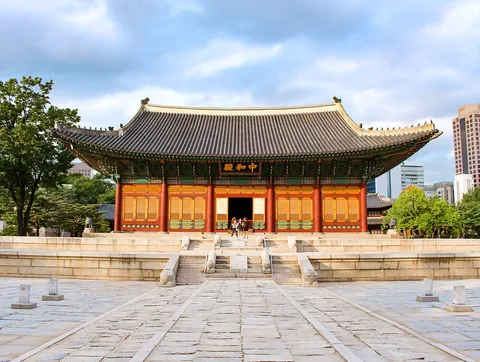
Joseon palaces beneath glass towers, Korean BBQ at midnight and the city of K-pop, K-drama and K-beauty.
Explore SeoulPhoto by Eunmi Park on Wikimedia Commons, CC BY-SA 4.0 (https://commons.wikimedia.org/wiki/File:%EC%A4%91%ED%99%94%EC%A0%84%EC%9D%98_%EB%82%AE.jpg)
Seoul’s Changdeokgung is a palace designed around its natural setting. Its official halls, residential courts and rear garden follow the terrain, making the relationship between buildings and landscape part of what you come to see. Check the separate viewing arrangements if the Secret Garden is on your list.
Gyeongju’s Bulguksa Temple draws attention to craftsmanship: wooden buildings stand on stone terraces, with bridges and pagodas expressing the Buddhist architecture of the Silla period. Jeonju offers a more domestic setting among the traditional houses of its Hanok Village, with bibimbap or bean-sprout rice soup for a meal afterwards.
In Busan, Gamcheon’s stepped houses and painted alleys are still part of a residential neighbourhood. Follow the current visiting hours and respect people’s privacy. Jeju shifts the focus to the coast. At Seongsan Ilchulbong, you can choose between a steep summit route and a gentler path through the surrounding scenery.
March to May (spring, cherry blossom season at 12-22°C) and September to November (autumn foliage at 12-22°C) are the best times. Summer (June-August) is hot and humid with monsoon rain. Winter (December-February) is cold (-5 to 5°C) but good for skiing and less crowded.
Visit Changdeokgung: Explore the royal courts and buildings, checking garden reservations separately if you want to include them.
Look closely at Bulguksa: Compare its stone terraces, bridges and pagodas with the wooden temple buildings above.
Walk through Jeonju Hanok Village: Follow the streets of traditional houses and try one of the city’s rice dishes.
See Gamcheon’s art: Browse murals and sculptures within permitted visiting hours, keeping noise down and asking before photographing residents or their homes.
Explore Seongsan Ilchulbong: Choose a route that suits you and check current access before setting out around this volcanic coastal landmark.
Destination photographs, not photographs of a specific holiday deal. Images resized for display.
Direct flights from London Heathrow to Seoul Incheon (ICN) in 11 hours with Korean Air, Asiana and British Airways. Incheon Airport is connected to central Seoul by the AREX express train (43 minutes to Seoul Station). Jeju is 1 hour by domestic flight from Seoul (the world's busiest air route).
A Korean meal often arrives as rice and soup surrounded by banchan, the small side dishes that let you combine different tastes with each mouthful. Bibimbap puts rice, vegetables and other toppings into one bowl, mixed with gochujang chilli paste.
At a barbecue restaurant, try grilled pork belly wrapped in a lettuce or perilla leaf with sauce. Jeonju adds its own bibimbap and kongnamulgukbap, a bean-sprout and rice soup. Makgeolli, a Korean rice wine, is another part of the city’s food culture.
Currency: Korean Won (KRW). Language: Korean (English limited outside Seoul's tourist areas). Time zone: KST (GMT+9). Visa and entry: see Visa Advisory above. Plug type: Type C/F (European two-pin). Tap water: Safe but most locals drink filtered. Driving: Right-hand side. Tipping: Not expected (can be considered rude in some contexts). T-money card covers all metro and bus transport in Seoul.
The main Joseon-dynasty palace in central Seoul was built in 1395 and reconstructed after Japanese occupation. The changing of the guard ceremony runs twice daily at the Gwanghwamun main gate.
Charcoal grills at the table, marinated galbi short ribs and samgyeopsal pork belly cooked and scissored by servers, wrapped in lettuce leaves with ssamjang sauce. The defining communal meal.
Six hundred preserved hanok wooden courtyard houses line the hillside between Gyeongbokgung and Changdeokgung palaces. Many now hold craft shops, tea houses and guesthouses. Best walked at dusk.
The Demilitarized Zone on the border with North Korea is 250 kilometres long and 4 kilometres wide, dotted with infiltration tunnels, observation platforms and the eerie Joint Security Area.
The volcanic UNESCO Geopark off the south coast has Mount Hallasan, lava tubes, waterfalls, tangerine groves and haenyeo female free-divers who still harvest abalone from the rocky shores.
The hillside shantytown above Busan harbour was painted in pastel colours in a 2009 arts project and is now one of Korea's most photographed neighbourhoods, with cafes, murals and sea views.
ETA required
UK passport holders need a Korea Electronic Travel Authorisation (K-ETA) for visa-free visits to South Korea for stays up to 90 days. Apply online at k-eta.go.kr (cost approx KRW 10,000 / £6, processed within 72 hours, valid for 3 years or passport expiry). Note: K-ETA exemption was extended to UK travellers from April 2024 through to 31 December 2026 — during the exemption, K-ETA is recommended but not strictly required for tourists; check current status before travel. Passport must be valid for the duration of stay. All travellers must also complete an electronic Customs Declaration via the Q-CODE system or paper form on arrival. Effective May 2026 — check gov.uk/foreign-travel-advice/south-korea for current rules before booking.
No mandatory vaccinations. Be up to date with routine UK vaccinations including tetanus; hepatitis A recommended; Japanese encephalitis considered for longer rural stays. Tap water is technically safe in major cities (Seoul, Busan) but most Koreans prefer bottled or filtered water. Healthcare is excellent (Severance, Asan Medical Center, Samsung) but expensive without insurance. Strong sun and humidity in summer (Jul-Aug 30°C+); cold and dry in winter (down to -10°C in Seoul, -20°C in mountains) — layering essential. Comprehensive travel insurance with full medical cover essential. Effective May 2026 — check fitfortravel.nhs.uk for any updates before travel.
Entry and health requirements can change. Check current official travel advice (opens in a new tab) for your passport and circumstances.
Confirm dates and arrangements before making travel plans.
Early to mid-April brings sakura to Seoul's Yeouido Park, Gyeongju's Bomun Lake and Jeju's tangerine groves. Festivals, night-time illuminations and picnics under the trees fill the calendar.
Late October and November see Seoraksan, Naejangsan and Namsan's maples turn scarlet and gold. Hikers and photographers flock to the national parks for the dry clear weeks before winter.
Ten days of Asian and international film premieres at Haeundae's Busan Cinema Center, the largest film festival in Asia and a key launchpad for Korean cinema's global reach.